











How Hearing Aids can help you improve Speech Clarity
You have probably heard someone
say, "I can hear people talking, but I cannot understand what they
are saying."
This is the most common frustration
among people with hearing loss. Sounds seem loud enough, but words sound
mumbled, blurred, or jumbled together. Conversations feel like a puzzle you are
constantly trying to solve.
If this sounds familiar, you are not
alone. The ability to hear versus the ability to understand are two different
things and speech clarity is what bridges that gap.
This blog explains why speech becomes
unclear, how hearing aids improve clarity, and what features you should look
for to have effortless conversations again.
Why Speech Becomes Unclear: The Science Simplified
Hearing loss does not affect all
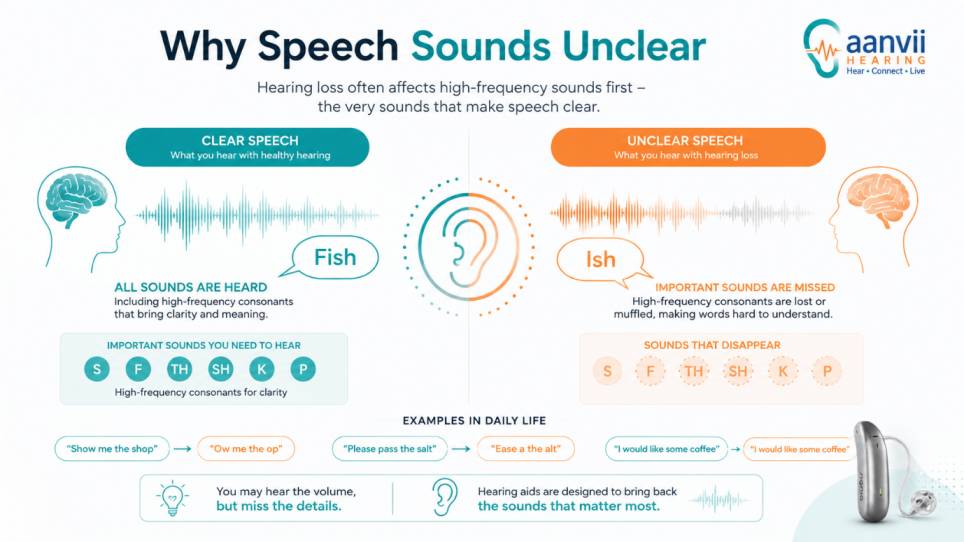
sounds equally. Most people lose high-frequency sounds first
and these are exactly the sounds that give speech its clarity.
Which sounds become harder to hear?
·
Consonants like F, S, TH, SH, K, P
·
Soft speech sounds at the beginning or end of words
·
Women's and children's voices (naturally higher-pitched)
What you hear instead:
|
What Someone Says |
What You Might Hear |
|
"Fish" |
"Ish" |
|
"Show me the shop" |
"Ow me the op" |
|
"Please pass the salt" |
"Ease a the alt" |
You hear the loud, low-frequency
parts of speech (vowels) but miss the soft, high-frequency consonants that
carry meaning. That is why sound is loud enough — but clarity is missing.
How Hearing Aids Improve Speech Clarity
Modern hearing aids are not simple
amplifiers. They are sophisticated computers that process sound intelligently
to restore clarity.
1. Frequency-Specific Amplification
Basic amplifiers make everything
louder including background noise. That does not help clarity.
Premium hearing aids are programmed
based on your unique hearing test results. They provide:
·
More amplification where your loss is worse (usually high frequencies)
·
Less amplification where your hearing is still good
·
No amplification for frequencies you hear normally
This precision is what makes speech
clearer, not just louder.
2. Noise Reduction Algorithms
Background noise is the enemy of
speech clarity. Modern hearing aids use advanced algorithms to:
·
Identify steady background sounds (fans, traffic, refrigerator hum)
·
Reduce those sounds without distorting speech
·
Preserve the sudden, changing sounds of conversation
3. Directional Microphones
These microphones focus on sounds
coming from in front of you, where conversation typically happens while
reducing sounds from behind and beside you.
How it works:
·
Omnidirectional mode: Hears all around (useful for quiet
environments)
·
Directional mode: Focuses forward (essential for noisy restaurants or group
settings)
Many modern hearing aids switch
between these modes automatically based on your environment.
4. Speech Enhancement Technology
This is where premium platforms
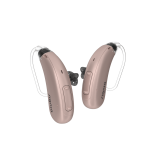
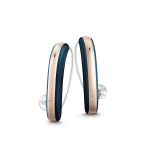
like Signia's Integrated Xperience (IX) shine. Speech
enhancement algorithms:
·
Analyze the sound scene hundreds of thousands of times per second
·
Identify speech from sound
·
Boost speech while suppressing noise
·
Track multiple speakers as conversations move
Signia's RealTime Conversation
Enhancement is specifically designed for this keeping every voice clear, even
when people talk over each other or when you are not facing them directly.
Read
more: What Hearing Aid Sound Quality Really Means and Why It Matters
Real-Life Example: Clarity in Action

The situation: You are at a family gathering.
Your niece is speaking from across the table. Someone else jumps in. People are
laughing. Dishes are clattering.
Without good speech clarity: You hear that people are
talking. You hear the loudness. But words feel mashed together. You nod and
smile, pretending to understand. After a while, you stop trying.
With advanced speech clarity (Signia
IX): The hearing aids identify your niece's voice and make it clearer.
When another person speaks, they automatically adjust. Background noise is
reduced but not removed — so you still feel present in the room. You understand
the conversation. You stay engaged.
That is the difference between
hearing and understanding.
Can Hearing Aids Restore 100% Normal Clarity?
This is an honest question that
deserves an honest answer.
No hearing aid can completely restore
normal hearing. Even the most advanced device is a tool, not a cure.
However, for the vast majority of
people with mild to moderate hearing loss, modern hearing aids can
restore 90-95% of speech clarity in quiet and moderately noisy
environments. In very challenging situations (a crowded, echoey restaurant),
clarity may still be harder but significantly better than without aids.
The goal is not perfection. The goal
is effortless enough that you stop struggling and start
participating.
Tips for Getting the Best Speech Clarity from Your Hearing Aids
1. Get a Real-Ear Measurement Fitting
Many clinics simply program hearing
aids based on your audiogram and call it done. For the best clarity, ask an
expert audiologist for real-ear measurement test that measures
exactly how sound is reaching your eardrum. This ensures your aids are
perfectly calibrated for your unique ear canal.
2. Use the Right Program for the Environment
Many premium hearing aids have
multiple programs. Do not just set them once and forget them.
·
Quiet program: For home, one-on-one conversations
·
Restaurant program: For noisy, crowded spaces
·
Outdoor program: For wind and traffic
·
Music program: Preserves natural tone and melody
3. Practice Listening
Speech clarity improves with use.
Your brain needs time to relearn sounds it has not heard clearly in years.
·
Wear your aids consistently (not just when you "need" them)
·
You can try to listen to audiobooks while following the captions
·
Have conversations in slightly challenging environments (not too noisy,
not silent)
4. Keep Your Aids Clean
Wax or debris blocking the microphone
or receiver destroys clarity. Clean your aids daily as instructed by your
audiologist.
5. Schedule Follow-Up Appointments
Your first fitting is not the final
fitting. Return for adjustments after wearing your aids for a week or two.
Small tweaks by professional audiologists can make a dramatic difference in
clarity.
Why Choose Aanvii Hearing for Better Speech Clarity

With 87+ clinics across India, Aanvii Hearing focuses on one thing above
all else — helping you understand conversations, not just hear sounds.
Our approach starts with a free comprehensive hearing test that identifies exactly which frequencies are robbing you of clarity. We then discuss your lifestyle to understand where clarity matters most, whether that is restaurants, family dinners, or work meetings. From there, we recommend premium technology like Signia IX, which is built specifically for RealTime Conversation Enhancement.
Before you commit, you get a free
real-world trial to test clarity in your own life, not just a quiet clinic
room. And because your first fit is just the starting point, we offer follow-up
fine-tuning until everything feels right. No two ears are the same, and
your path to better clarity should be as unique as you are.
Read more: Why Routine Hearing Tests are Important for Everyone
Ready to Hear the Difference? Let's Start with a Free Trial
You can read articles all day. But nothing replaces sitting across from someone and understanding every word effortlessly. That feeling is closer than you think.
Book a Free Hearing Test & Trial at Aanvii Hearing
Call us at 96 5839 5839 or visit www.aanviihearing.com to book your free hearing test and real-world
trial today.
Clarity changes everything. Experience it for
yourself.
