









A Simple Guide to the 8 Types of Hearing Tests and Measurements

If you have never had a thorough hearing evaluation, you might think it is just about raising your hand when you hear a beep. That is part of it. But a complete hearing assessment involves several different tests, each telling the audiologist something specific about your ears.
This guide explains the eight most
common types of hearing tests, what each one measures, and why it matters. At
the end, we will also clarify which tests are available at Aanvii Hearing.
Why Multiple Tests Are Needed
Your hearing system is complex. Sound
travels through the outer ear, then the middle ear, then the inner ear, and
finally along nerve pathways to your brain. Problems can show up anywhere along
that chain. One single test cannot pinpoint exactly where the issue is. Each
test answers a different question.
1. Pure Tone Audiometry (PTA)
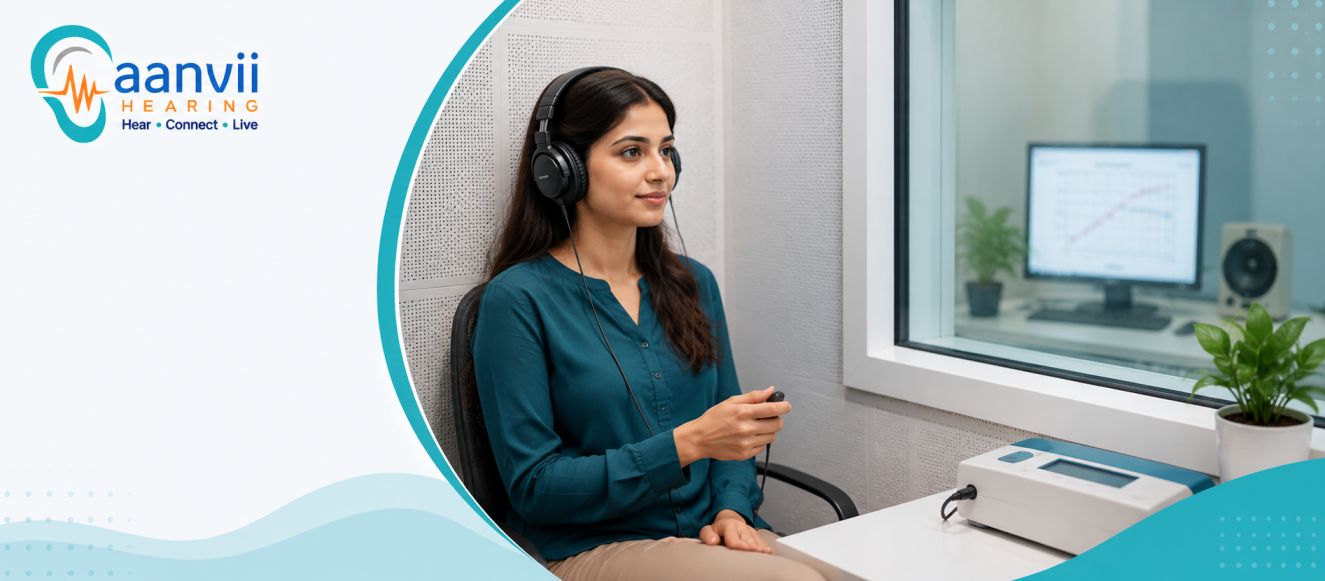
This is the familiar beep test. You
sit in a quiet room wearing headphones. The audiologist plays tones at
different pitches and volumes. Your job is to press a button every time you
hear a sound, no matter how faint.
Why it matters: PTA creates your
audiogram, the chart that shows your hearing levels across different
frequencies. It tells the audiologist which sounds you hear normally and which
you miss.
What to expect: The test takes about 20 minutes. It is not painful.
2. Speech Audiometry
Hearing beeps is one thing.
Understanding words is another.
This test has two parts. Speech
reception threshold finds the softest level where you can repeat two syllable
words correctly. Word recognition score measures how clearly you understand single
syllable words at a comfortable volume.
Why it matters: Two people with
identical beep test results can have very different word recognition scores.
This affects how well they will do with hearing aids.
What to expect: You repeat words out
loud. The test takes 10 to 15 minutes.
3. Bone Conduction Testing
Regular hearing tests send sound
through air, down your ear canal, and through your middle ear. Bone conduction
testing sends sound straight to the inner ear, completely skipping the outer
and middle ear.
How it works: A small device that
vibrates gently is positioned behind your ear, right against the bone. Those
vibrations travel straight to your inner ear.
Why it matters: Comparing air
conduction results with bone conduction results tells the audiologist where the
problem is located. If both show the same loss, the issue is likely in the
inner ear. If only air conduction shows loss, the issue is in the outer or
middle ear.
What to expect: A gentle vibration behind your ear. Takes about 10 minutes.
4.Tympanometry (Impedance Audiometry)
This test measures how well your
eardrum moves. It tells the audiologist about the health of your middle ear.
How it works: A soft probe is placed
at the opening of your ear canal. The probe creates a small change in air
pressure and measures how much sound bounces back from the eardrum.
Why it matters: Tympanometry can
detect fluid behind the eardrum, a perforated eardrum, stiffening of the middle
ear bones, or a blockage in the ear canal.
What to expect: You will feel a brief change in pressure, like descending in an aeroplane. Takes less than two minutes per ear.
Also Read: 6 Must-Have Features to Look for in the Best Hearing Aids
5. Acoustic Reflex Testing
Deep inside your middle ear, tiny muscles
contract automatically in response to loud sounds. This is called the acoustic
reflex.
How it works: A small, soft tip goes
into the opening of your ear canal. The audiologist plays loud sounds and
measures whether the reflex occurs.
Why it matters: This test can help
locate the site of a hearing problem and detect certain types of nerve damage.
What to expect: You will hear loud
sounds. They are not painful but can be startling. Takes about five minutes.
6. Otoacoustic Emissions (OAE)
This is an objective test that does
not require any response from you. It measures sounds that your inner ear
produces on its own.
How it works: A small probe in your
ear canal plays clicking sounds. A healthy inner ear responds by producing its
own faint emissions, which the probe detects.
Why it matters: OAE is commonly used
for newborn hearing screening. It detects inner ear damage before it shows up
on a standard hearing test.
What to expect: This test asks
nothing of you except to stay still. No button pressing. No repeating words.
7. Auditory Brainstem Response (ABR)
This test measures how sound travels
from your inner ear to your brainstem.
How it works: Small electrodes are
placed on your scalp and earlobes. Clicking sounds are played through
headphones. The electrodes measure electrical activity in your auditory nerve
and brainstem.
Why it matters: ABR is used for
newborn hearing screening, diagnosing acoustic neuromas, and assessing hearing
in adults who cannot complete standard testing.
What to expect: You sit or lie down
comfortably and remain still. Takes 30 to 60 minutes.
8. Cortical Evoked Response
Audiometry (CERA)
This is the most advanced
electrophysiological test. It measures sound processing at the auditory cortex,
the part of your brain that consciously perceives sound.
Why it matters: CERA is used when
standard testing is not possible, such as for individuals with severe
developmental disabilities or in medico-legal cases where objective evidence is
required.
What to expect: The test takes 60 to 90 minutes.
Also Read: The Benefits of Custom-Fit and Instant-Fit Hearing Aids
What Hearing Tests Does Aanvii
Hearing Provide?
At Aanvii Hearing, we focus on the core tests that are essential for understanding your hearing and determining the right course of action.
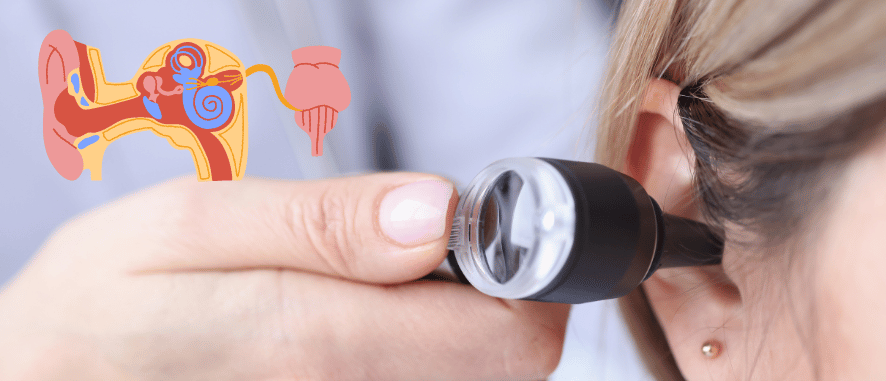
Otoscopy. This is a visual examination of
your ear canal and eardrum using an otoscope. It helps us check for earwax
blockages, signs of infection, or structural abnormalities.
Pure Tone Audiometry (PTA). This is the standard beep test.
At Aanvii Hearing, the PTA test is provided free of charge. Please note that
while the test is free, the detailed printed report may involve a nominal
charge.
Impedance Audiometry (Tympanometry). This test measures how well
your eardrum moves and checks the health of your middle ear. It helps us detect
fluid behind the eardrum or eustachian tube dysfunction.
These three tests give us a clear and
reliable picture of your hearing health. For most people, this is sufficient to
understand their hearing loss and determine whether hearing aids would be
beneficial.
Other tests like Speech Audiometry,
Bone Conduction Testing, OAE, ABR, and CERA are part of a comprehensive
diagnostic battery. These are typically performed in hospital settings or
advanced audiology centres. If your situation requires any of these additional
tests, our audiologist will guide you accordingly.
Conclusion
Understanding the different types of
hearing tests can take away the fear of the unknown. Pure tone audiometry maps
your hearing. Tympanometry checks middle ear health. Speech testing measures
word understanding. OAE and ABR provide objective measurements without your
active participation.
At Aanvii Hearing, we provide otoscopy, pure tone audiometry (free test, reports at nominal charge), and impedance audiometry at our 87+ clinics across India.
Book a Free Hearing Test & Trial at Aanvii Hearing
Ready to get your hearing checked? Call 96 5839 5839 or
visit www.aanviihearing.com to find the Aanvii Hearing
clinic nearest to you.
Knowing where your hearing stands is
the first step toward better hearing.
